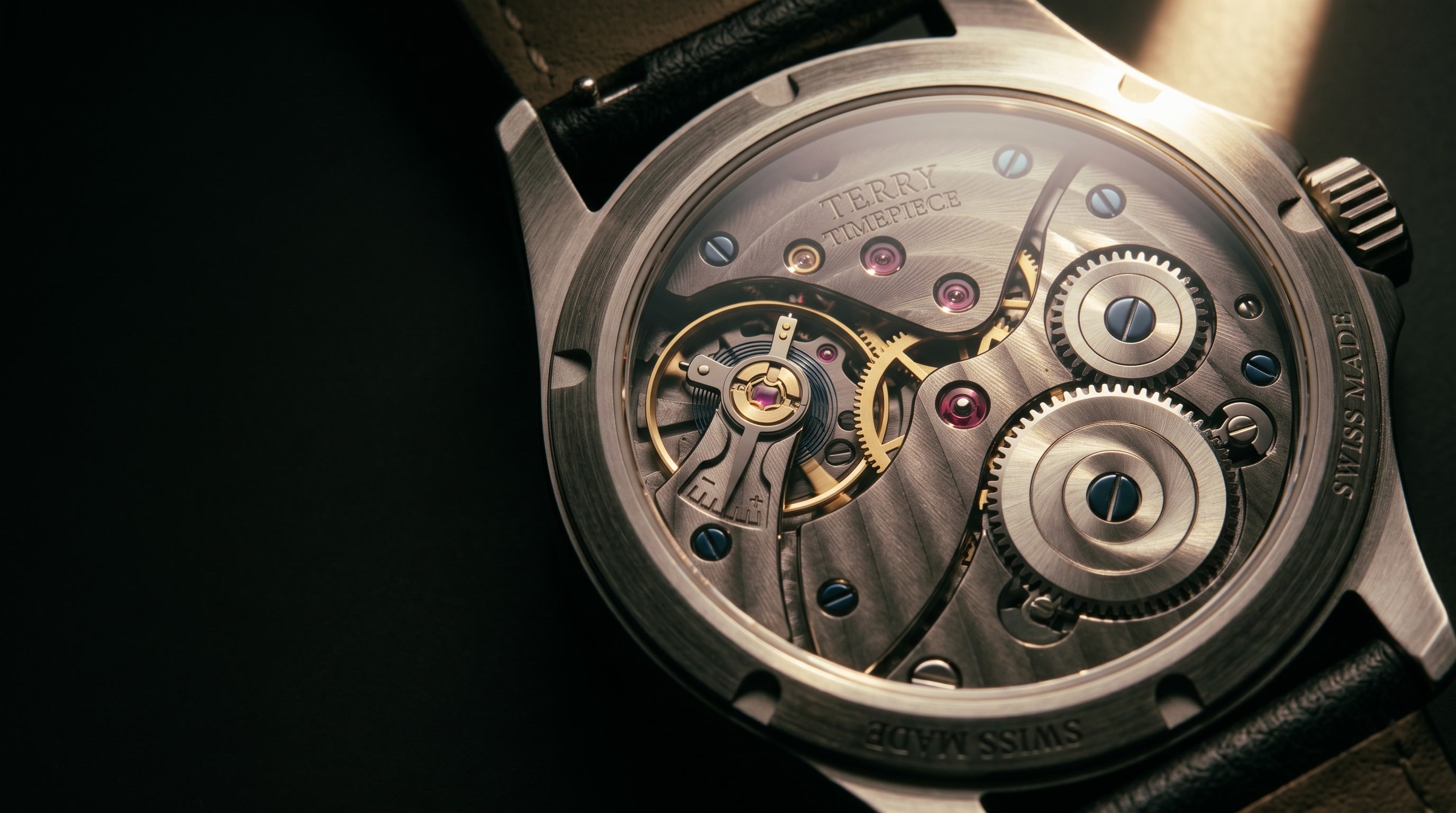
Turn a Terry Timepiece over and the movement is doing something very simple, very precisely. A spring wants to unwind. A train of wheels lets it unwind slowly. An escapement lets it unwind in equal instalments. That is the whole idea, and it has not needed improving for two hundred years.
The mainspring, and the problem with it
Energy is stored in a coiled ribbon of steel inside the barrel. Wound fully, it pushes hard. Nearly unwound, it pushes weakly. If that difference reached the balance wheel unmodified, the watch would run fast in the morning and slow by evening.
Most of the cleverness in a mechanical movement is spent hiding this problem rather than solving it — the escapement is designed so that how hard it is pushed matters far less than you would expect.
The escapement, which is the interesting part
The balance wheel swings back and forth, and it wants to do so at its own rate regardless of how hard it is pushed. That property is what makes a watch a clock rather than a slowly unwinding spring. The hairspring sets that rate; the pallet fork feeds it just enough energy to keep going and counts the swings on the way past.
Twenty-eight thousand eight hundred times an hour, something the width of a hair decides what time it is.
Why there are rubies in it
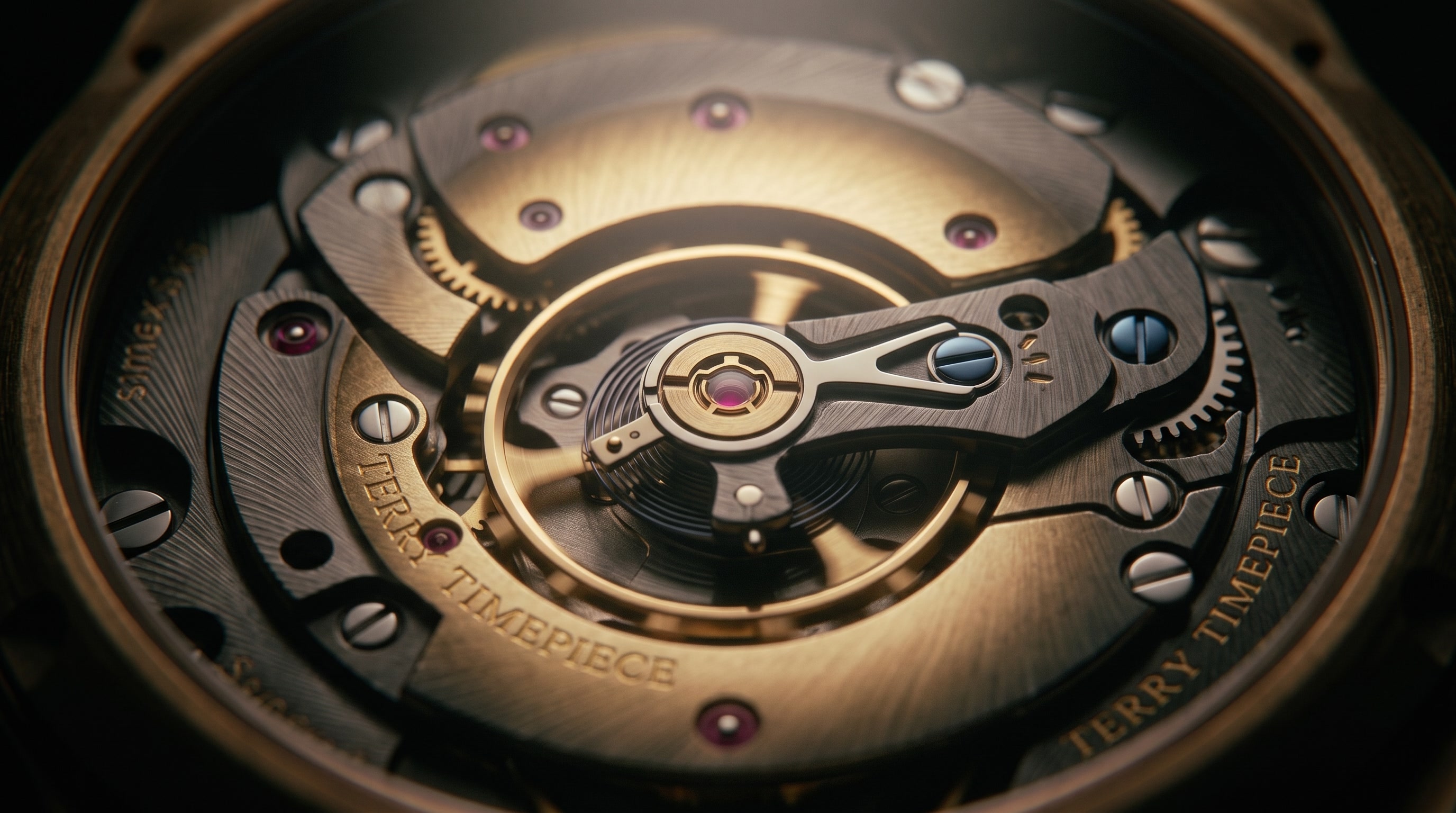
The red stones are synthetic sapphire, and they are bearings. Steel pivots turning in steel plates wear out; steel pivots turning in polished corundum effectively do not. There are twenty-one of them, placed where loads are highest, which is why the count appears on the movement at all — it says something true about how long the watch will run.
What the finishing is for
Circular graining on the bridges, bevelled edges, blued screws: none of it makes a watch keep better time. On expensive movements it is the visible residue of someone having looked closely at every surface. On affordable ones it is applied by machine, and there is no shame in that either — what it decorates still works.
That is the honest limit of it. Finishing is not function, and we would rather say so than imply that a prettier bridge keeps better time. It does not.
Every part comes back out
Every one of them can be removed with tools a watchmaker already owns. No part is bonded to another. When this movement stops — and one day it will — somebody will be able to open it and find out why. That is true of a cheap automatic as much as an expensive one, and it is the reason to own either.
That is not nostalgia. It is the only definition of durable that survives contact with a workshop.